
Leadership Profile: Zig Ziglar

I had the privilege of meeting the late Zig Ziglar (1926-2012) a couple years ago at a seminar in Richmond, VA. Zig’s words and ideas have impacted my life probably more than any other thought leader out there. It was truly one of the highlights of my year getting to meet the man who literally wrote the book on success. I realize not everyone has been acquainted with America’s “Master of Motivation,” so six weeks after his passing, I’d like to pay tribute to Zig Ziglar in my first leadership profile of the new year.

Me and Zig

Both Zig Ziglar and I will see you at the top!

Coach Bill Snyder’s 16 Goals for Success

I’m a sucker for leadership philosophies embraced by successful athletics coaches. Whether it’s Coack K on teamwork or Coach Burton on developing high school kids, I always come away with something powerful and enriching. I think the reason is that athletics provides one of the greatest leadership development opportunities out there because players learn to work as a team toward a common goal in a competitive environment. In short, it’s leadership development training for life.

Coach Bill Snyder

If you follow college football at all, you might have been surprised when Kansas State University climbed to #1 in the BCS Poll at one point this football season.

The Value of Asking “Why?”

Why? It’s one of my all-time favorite questions. I’m told I asked my parents, “why?” over and over again as a kid and apparently I’ve never grown out of it. There’s no quicker way to cut to the heart of what’s most important, which is one of the greatest responsibilities leaders have. And I’m not the only one who thinks so. In his landmark book Getting Things Done, David Allen shares six distinct ways asking, “why?” adds value. They are too good to keep to myself, so I’ve listed them here below with my own short commentary.

Why

Resilience and the Pan Am Flight 73 Hijacking

A couple summers ago I had the incredible opportunity to attend a one week Dynamics of International Terrorism course with the Air Force Special Operations.  I’m still not sure how I had the good fortune to attend.  We heard from military, law enforcement, and security officers who were on the ground during many of the high profile terrorist attacks from the last few decades, such as the Khobar Tower bombings, the 9/11 World Trade Center attacks, the Mumbai hotel attacks, and the kidnapping of General Dozier by the Italian Red Brigade (presented by General Dozier himself).

Pan Am flight 73As enthralled as I was with the presentations, one poignant leadership lesson stood out which I knew I’d have to eventually share.  It came from a story Richard Melhart relayed to us.  

How to Build a Development Library for Your Organization

Files OrganizedIn my last post I wrote about Individual Development Plans and how you can use them to develop in a professional setting.  This week I’ll tell you how to build a development library for your organization.

What is a Development Library?

A development library is simply a collection of organizational suggested or sponsored developmental experiences that employees can choose from as they consider their own development plans.  When you go to an actual library, you browse the shelves until you find one (or several) book that meets your reading objective.  It’s the same principle with a development library.

How to Complete an Individual Development Plan

Perhaps you’ve heard of the professional growth tool called the Individual Development Plan (or IDP for short). They often prove handy for many organizations seeking to develop employees’ skills (leadership & functional) in preparation for what’s next. In some cases, entire sectors (such as the U.S. government) require the completion of IDPs on an annual or semi-annual basis. Other organizations have a more ad hoc system involving the use of IDPs.

IDP

So what makes the IDP so special? In this post I’ll explain what an IDP is, why it’s so important, and then share some steps showing how to complete one. At the bottom of the post I’ll include a link to an IDP template you can use for yourself or your team.

The Power of Believing the Best

Several years ago I had the pleasure of participating in a 16 week leadership coaching training course with the Center for Coaching Excellence (CCE). Since that time I’ve had the pleasure of coaching a number of of business owner or organizational leaders. I enjoyed the insight and techniques I was taught, but the most significant thing I came away with was the relational effectiveness of CCE’s core values for coaching. For anyone wanting to influence others, I think it represents the bottom line.

The value that stood out the most was “believing the best” about other people. Think about that one for a minute. What does believing the best actually mean? How often when we talk or relate with someone do we believe or assume the absolute best about the other person? What could happen if we did? What would it take to get there?
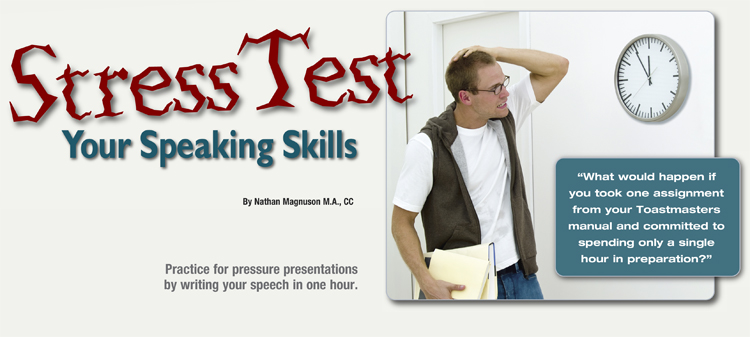
Article Preview: Stress Test Your Speaking Skills

Last year I got the opportunity to write an article for Toastmaster Magazine.  I put my heart and soul into writing a funny and helpful article that related my experiences in Army Special Operations training to the pressure of preparing a professional presentation on short notice.  I learned one thing: if you’re fortunate enough to have an article featured in a publication with over 270,000 subscribers, someone is bound to read it!  Even though the article ran in April, 2011, I recently received an email from a Toastmasters Club member in the UK saying how he’d like to organize a “stress test” speaking event, like I wrote about in the article.

Style Sheets Master
As I mentioned in my last post, I’ve had a blast in my pursuit to become a competent public speaker.  However, if I hadn’t practiced, I wouldn’t have been nearly as effective under pressure.  That’s why I’ve invested in programs like Toastmasters and Dale Carnegie.

Six Reasons You Should Give Public Speeches

Public SpeakerOne of the ideas I really latched on to when I started taking leadership courses in graduate school was John Maxwell’s quote, “everything rises and falls on leadership.”  But I was also challenged by a response my leadership friends came up with, that leadership rises and falls on communication.  If they were right, then it didn’t matter what I learned about leadership if I couldn’t communicate it.  A quick self-assessment revealed that I could write, converse, and lead small group discussions, but I lacked training and experience speaking in front of groups.

Right then and there I promised myself I would become a better public speaker.